

According to recent reports, there is an “absence of troubling labor market data.” Indeed, the monthly employment report released last week shows modest hiring and relatively few layoffs, with employers holding on to existing workers and adding new ones only when they can find candidates with exceptional skills and experience. The supply of such workers, however, is limited.
Weakness on two fronts
The job market, therefore, is characterized by both low demand and low supply, validating Federal Reserve Chair Jay Powell’s recent comment that the key variable to watch is the unemployment rate. This observation is more insightful than it may first appear. What Powell meant is that, rather than focusing on the absolute number of jobs available, the critical issue is the balance between job openings and the number of people in the labor market. If employment and job openings decline together, the unemployment rate can remain stable, suggesting balance. Lost in this calculation, however, is the fact that economic vibrancy suffers when both employment and participation fall.
Stimulating the economy to create more jobs would do little if the labor pool itself is not expanding. Increased demand for workers under those conditions would simply bid up wages for existing employees, putting upward pressure on inflation. Monetary tightening would have the opposite effect.
The reality, however, is that the unemployment rate has been steadily rising—from a 50-plus-year low of 3.4% in 2023 to the current level of 4.4%. This long, gradual increase is unprecedented in the U.S. outside of recessions, and it is troubling. The reasons behind it are not entirely clear.
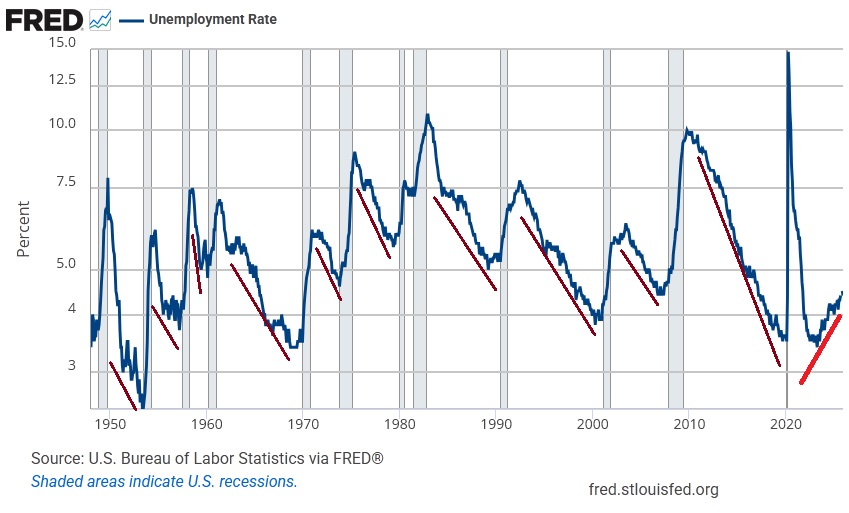
A rising unemployment rate can result either from an increase in the number of unemployed people or from a decline in labor force participation. Evidence suggests that both are occurring simultaneously.
Fewer people working
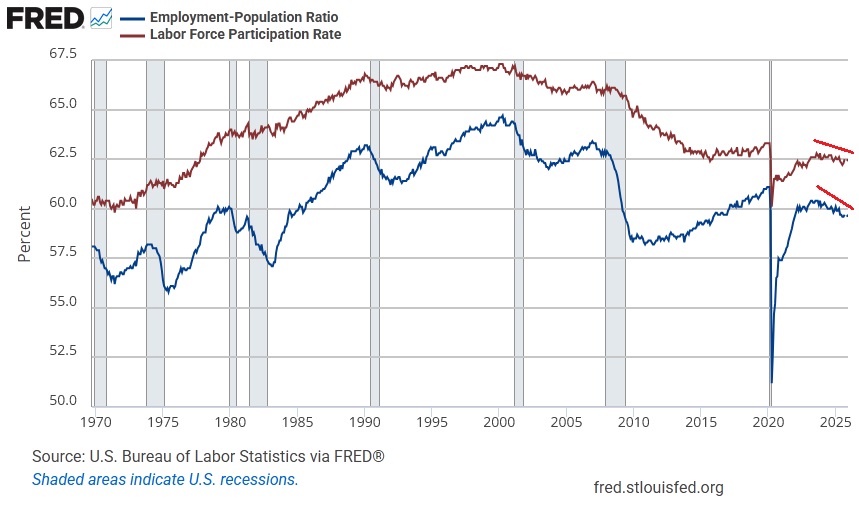
The employment-population ratio—the share of the total population that is employed—has been on a long-term decline since its peak in the early 2000s. It collapsed during the pandemic, partially recovered, and is now falling again. The labor force participation rate—the share of people either working or actively seeking work—shows a similar pattern. In short, not only are fewer people employed, but fewer people are even looking for work. The labor force, in other words, is shrinking.
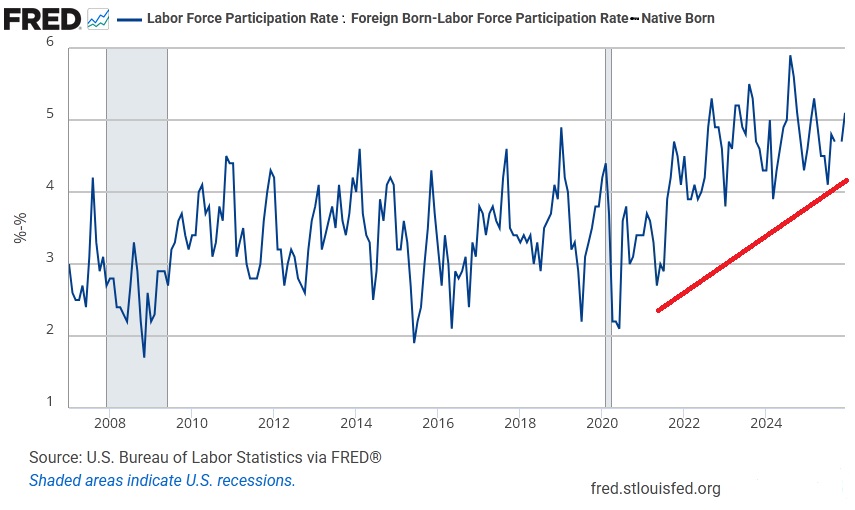
One notable aspect of this trend is that labor force participation among foreign-born workers has outpaced that of native-born workers, yet recent crackdowns on immigration have reduced their numbers. By shrinking the segment of the population most likely to work, these policies are contributing to the continued decline in the employment-population ratio, which, outside of the period immediatly after the pandemic, is approaching levels not seen since the 1970s.
Another factor influencing the unemployment rate is the decline in job openings. One commonly cited explanation is the growing use of artificial intelligence, which can replace workers performing certain tasks. However, this effect is not yet clearly visible in the data.
Is AI killing jobs?
Challenger, Gray & Christmas, a global human resources firm, publishes a detailed report on job cuts. In 2025, the largest source of job losses stemmed from DOGE-related actions that eliminated government jobs as well as downstream private-sector positions, accounting for 24% of all layoffs. “Market and economic conditions” followed at 21%, with company closures (16%) and restructuring (11%) close behind. Artificial intelligence and technological updates accounted for just 6% of total job losses, though that share had been only 2.6% at mid-year. AI may become a more significant threat to employment in 2026, a development worth monitoring—particularly given that unemployment among 16- to 24-year-olds, the group most vulnerable due to their concentration in lower-skill, entry-level jobs, has reached its highest level in nearly a decade.
In sum, while there are no immediate signs of an employment crisis, several indicators point to a clear and steady deterioration that has been unfolding for multiple quarters, if not longer. Whether this represents a slow, gradual change that the economy can adapt to, or instead a trajectory toward a tipping point that could quickly escalate into a broader crisis, remains uncertain.