

Until recently, warnings about AI-fueled market strength seemed to leave investors unmoved. The Magnificent Seven had a, well, magnificent performance in the second quarter. The tech sector as a whole also had a good run between late July and early August, especially compared to the S&P 500 index stripped of tech stocks. But the latest round of earnings calls last week brought sharp declines – and with them, a new level of concern about the AI trade.
Google, for example, slumped more than 20% in less than three weeks. Intel plunged an eye-popping 48% since the beginning of the quarter. SpaceX fell 16% in just over three weeks to just below its IPO price and 33% below its peak. Meta (Facebook) has a negative return for the year, compared to +10% for the S&P 500. Other recent market darlings have also suffered significant losses amid mounting worries about the tech sector's outlook.
Much of the concern revolves around the staggering amounts AI companies plan to spend on data centers and specialized chips. Recent analyses suggest that aggregate investment plans by AI suppliers exceed $4 trillion over the next five years, while projected demand from the rest of the corporate world amounts to only about $1.5 trillion over the same period. That gap raises serious questions about whether the investments will pay off, particularly if, absent a surge in demand for AI, companies must finance much of that spending through debt at elevated interest rates.
Whether tech companies are too optimistic or their customers too conservative is anybody's guess. Investors, however, appear increasingly reluctant to wait years to see whether the promised rewards come true.
There is still plenty of money around
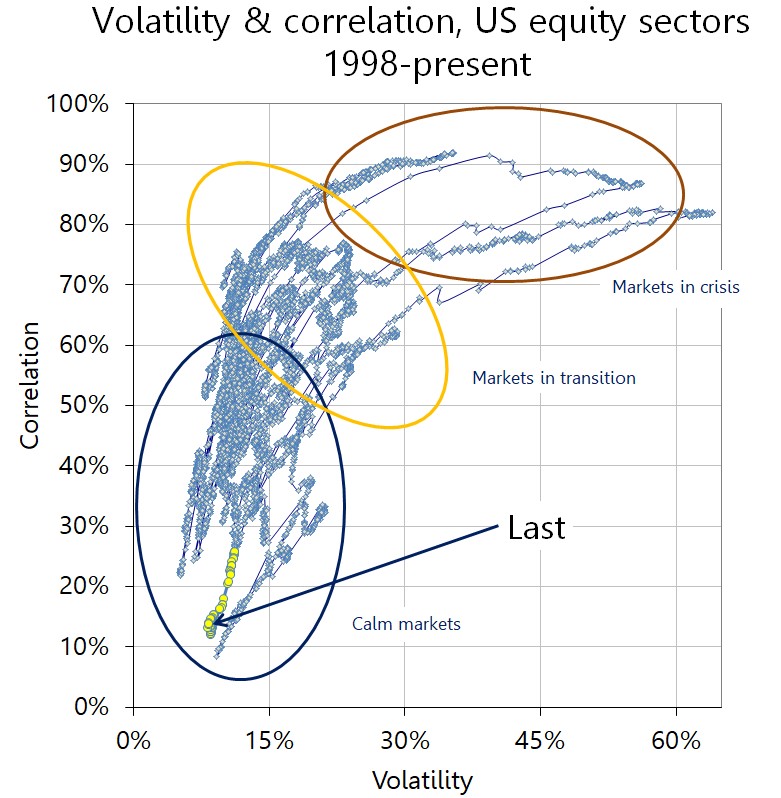
On the other hand, system-wide liquidity remains abundant, which means that plenty of money is available for investment. Money market fund assets are hovering near record levels, projected stock buybacks are at an all-time high, and the Federal Reserve has so far resisted raising interest rates despite rising inflation and an economy that remains hot. The Center for Financial Stability reports one of the highest rates of liquidity growth in almost 20 years, excluding the pandemic period.Market dynamics also offer some reassurance. A closer look at sector volatility and correlations suggests a market still behaving more like one in a sustained advance than one approaching a systemic collapse. As we have pointed out before, low volatility and low correlations among sectors are features of steadily appreciating markets, generally far from the risk of a crash.
Higher correlations suggest investors are selling with less regard for individual sectors, often a sign of faltering confidence and increasingly indiscriminate selling. Conversely, lower correlations suggest that investors remain confident about favoring some sectors over others, a pattern generally associated with stable, rising markets.
What if stocks crash and not every investor notices?
It may be that we are entering a new era of persistently lower sector correlations. In other words, when concerns arise, investors may be more inclined to punish the sectors directly affected rather than liquidate stocks indiscriminately. The latter behavior, of course, is what characterizes a broad-based market crash.Under such conditions, individual sectors could experience bear markets while money shifts toward more promising areas. This could spare the broad indices from a major decline even as the gap between winners and losers widens.
One example would be a continuation of the recent slump in AI and tech stocks alongside a rally in long-neglected value stocks. The growing divergence between these groups suggests that investors may already be rotating in that direction. In such a scenario, tech-heavy investors would bear the brunt of the losses while value investors would be spared.
Money talks
But this pattern can persist only while liquidity remains plentiful. If money dries up, the risk of a broad-based, indiscriminate selloff rises sharply. An obvious trigger would be a credit event, such as a significant bond or loan default. Such concerns are particularly relevant to highly leveraged areas, including private credit and heavily indebted companies such as CoreWeave, whose stock has lost 38% this quarter and more than 70% since last year's peak.In the end, it all depends on money—and how much of it is borrowed. Investors with cash can rotate it among different assets. Lenders with sufficient capital can refinance maturing debt or meet growing borrowing demand. And a Federal Reserve that refrains from raising rates or shrinking its balance sheet helps keep liquidity flowing and markets supported.
It doesn't take much, however, for this process to reverse. Heavily leveraged investors may be forced to liquidate positions to meet margin calls. Lenders spooked by a default somewhere in the system may pull back from refinancing maturing loans, potentially triggering further defaults. These dominoes can fall very quickly.
It bears remembering that credit stress and high leverage have played prominent roles in past crises, including the Savings and Loan crisis of the late 1980s and the Great Financial Crisis of 2008. Leverage, particularly margin debt, also amplified the damage when the dot-com bubble burst. With public and private debt ballooning worldwide, credit markets are fertile ground for the seeds of the next crisis.